
Any commercial EV charger equipped with a NACS (SAE J3400) connector is fully compatible with Tesla vehicles. For commercial operators deploying public stations or fleet depots in 2026, this means selecting hardware that supports both NACS and CCS1, ensuring your infrastructure serves the full range of EVs on the road today.
Most of the content you find on this topic targets homeowners shopping for a single wall charger. This guide is different. It is written for charging station operators, fleet managers, and commercial property developers who need to understand the NACS standard, select the right commercial-grade hardware, and deploy infrastructure that serves Tesla drivers along with every other EV on the road.
Key Takeaways
- NACS (SAE J3400) became the dominant North American charging standard in 2025, adopted by Ford, GM, Rivian, Toyota, Honda, and virtually every major automaker.
- Non-Tesla NACS public charging stalls grew over 40% in early 2026, exceeding 2,500 stalls across third-party networks.
- Commercial operators need dual NACS plus CCS1 chargers to serve both newer NACS vehicles and legacy CCS1 fleet.
- DC fast chargers in the 60–180 kW range deliver the strongest ROI for public stations, parking facilities, and fleet depots.
- Hardware reliability, OCPP compliance, and global delivery capability are the three factors that separate professional-grade commercial chargers from consumer-grade options.
What Is NACS and Why Does It Matter for Commercial Operators?
The North American Charging Standard, formally designated SAE J3400, is the charging connector that Tesla developed and used exclusively on its own vehicles for over a decade. In 2023, SAE International adopted it as an official industry standard. Within 18 months, nearly every major automaker announced plans to equip their North American EVs with NACS ports starting with model year 2025.
This shift changes the equation for every commercial charging operator in the region. As recently as 2023, deploying J1772 Level 2 stations and CCS1 DC fast chargers was sufficient to serve most EVs. Today, the vehicles arriving at your parking lot, your fleet depot, or your highway rest stop are increasingly equipped with NACS ports natively. Installing hardware without NACS support in 2026 means turning away a growing share of your customers.
NACS vs J1772 vs CCS1: Connector Standards Explained
Understanding these three standards helps you plan your hardware selection correctly.
NACS (SAE J3400) uses a single compact connector for both AC Level 2 and DC fast charging. It is now the default port on all Tesla vehicles and on 2025 and later models from Ford, GM, Rivian, Volvo, Mercedes, Nissan, Honda, and Toyota, among others. Tesla’s Supercharger network, which has more than 15,000 stalls open to all NACS vehicles in the United States, uses this connector exclusively.
J1772 is the standard AC charging connector that has been common across North America for years. Most Level 2 public stations still use J1772 or include it as one of two cable options. Tesla vehicles accept J1772 charging through the adapter that ships with every car.
CCS1 (Combined Charging System) is the DC fast charging standard that was dominant before the NACS transition. Many 2024 and earlier non-Tesla EVs still use CCS1 for DC charging. A meaningful portion of the commercial EV fleet, particularly logistics and fleet vehicles with longer replacement cycles, will use CCS1 for several more years.
The practical conclusion for commercial operators: deploy dual-connector hardware that supports both NACS and CCS1 for DC fast charging, and J1772 or NACS for Level 2 AC. This single decision future-proofs your investment.
Which EVs Use NACS in 2026?
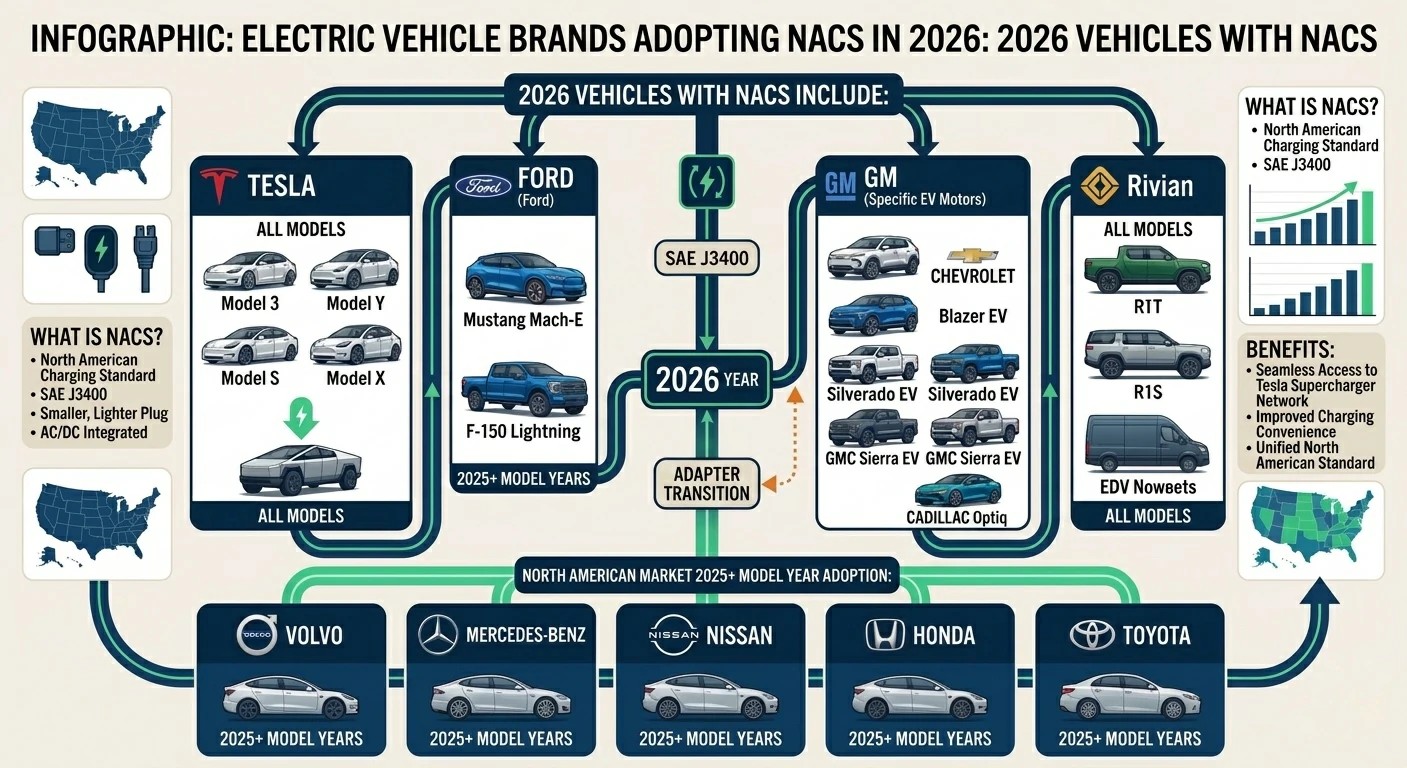
According to SAE International’s J3400 documentation and manufacturer announcements, NACS-equipped vehicles in 2026 include all Tesla models (Model 3, Model Y, Model S, Model X, Cybertruck), Ford Mustang Mach-E (2025+), F-150 Lightning (2025+), Chevrolet Equinox EV, Blazer EV, Silverado EV, GMC Sierra EV, Rivian R1T, R1S, and EDV commercial van, as well as 2025 and later vehicles from Volvo, Mercedes, Nissan, Honda, and Toyota’s North American lineup.
Owners of 2024 and earlier non-Tesla EVs with CCS1 ports can access NACS chargers through manufacturer-provided adapters. Ford and GM began distributing these adapters in 2024. This means a commercial NACS station already serves a broader audience than the connector name alone suggests. The US Department of Energy’s Alternative Fuels Data Center tracks NACS infrastructure deployment and vehicle compatibility across North America as adoption accelerates through 2026.
Types of EV Chargers Compatible with Tesla
Commercial operators have three primary charger categories to consider, each suited to a different deployment context. Choosing the wrong power level for a given site is one of the most common and costly mistakes in EV infrastructure planning. If you are still working through the higher-level decision of which charger type fits your project, our EV charger selection guide covers the full framework before you get into NACS-specific hardware.
Level 2 AC Chargers (7 kW to 22 kW): Best for Destination and Long-Stay Charging
Level 2 AC chargers deliver power through a J1772 or NACS connector at voltages between 208V and 240V. A 7 kW unit adds roughly 25 to 35 miles of range per hour, which is sufficient for vehicles parked for four or more hours. This makes Level 2 AC the right choice for hotel guest parking, workplace charging, residential buildings, and airport long-term parking.
For Tesla vehicles at a Level 2 station, the car accepts a J1772 connector through its included adapter or connects natively at a NACS Level 2 station. From an operator’s perspective, offering at least NACS-capable Level 2 hardware removes the dependency on the driver having their adapter available.
Klitv’s 7 kW AC charging pile is built for destination charging deployments. It features OCPP-compatible remote monitoring and a robust IP54-rated enclosure designed for reliable outdoor performance in any climate.
DC Fast Chargers (60 kW to 180 kW): Best for Public Stations, Retail, and Fleet Depots
This power range is the commercial gold standard for stations where drivers stop for 20 to 60 minutes. A 120 kW DC fast charger delivers a 20% to 80% charge for a mid-size EV in approximately 35 minutes. This aligns precisely with the dwell time at shopping centres, service stations, and rest stops.
For operators deploying hardware that serves Tesla drivers natively, DC fast chargers in this range need NACS connectors on at least one cable. Dual-connector units with both NACS and CCS1 cables on a single pedestal provide maximum vehicle compatibility from a single hardware investment.
The 60–80 kW DC fast charger and 120–180 kW DC charging pile from Klitv are built for this deployment tier, featuring OCPP 1.6 compliance for management platform integration and construction rated for continuous outdoor operation.
Need help selecting the right power level for your site? Contact our engineering team for a free project consultation.
High-Power Charging (360 kW+): For Highway Hubs and Heavy-Duty Applications
Supercharger-class power above 360 kW is appropriate for highway service areas, truck and bus depots, and large urban fast-charging hubs where vehicle turnover needs to be maximised. Klitv’s liquid-cooled 360–720 kW supercharger addresses this tier, designed for high-throughput commercial environments where sustained high-power delivery and thermal management are critical.
This power level requires detailed grid capacity assessment and often involves grid upgrades as part of the project scope.
Key Specifications for a Commercial NACS-Compatible Charger
Selecting a charger that is “compatible with Tesla” is only the starting point. For a commercial deployment to perform reliably over a five to ten year operational period, several technical specifications deserve close attention.
Connector Type: Dual NACS Plus CCS vs Single Standard
A charger with only a NACS connector serves Tesla vehicles and 2025+ NACS vehicles well, but leaves CCS1 vehicle owners without service. Dual-connector units that offer both NACS and CCS1 on the same DC fast charger eliminate this problem. For operators targeting maximum utilisation and revenue, dual-connector hardware is the correct specification.
Power Output: Matching Charger Capacity to Use Case
| Use Case | Recommended Power Output | Typical Dwell Time | Vehicles Served Per Day |
|---|---|---|---|
| Hotel and destination parking | 7–22 kW AC | 4–10 hours | 2–4 per port |
| Commercial parking, retail | 60–80 kW DC | 30–60 minutes | 12–18 per port |
| Service stations, highway stops | 120–180 kW DC | 20–40 minutes | 18–30 per port |
| High-traffic hubs, fleet rapid charge | 360 kW+ DC | 10–20 minutes | 30–50+ per port |
Oversizing power output for a low-turnover site wastes capital expenditure without proportional revenue benefit. Undersizing for a high-traffic corridor creates queuing and reduces customer satisfaction.
OCPP Compliance for Network Management
For any commercial multi-station deployment, OCPP 1.6 compliance is non-negotiable. The Open Charge Point Protocol enables your chargers to communicate with a charge management system (CMS), supporting remote monitoring, fault diagnostics, over-the-air firmware updates, load balancing across multiple units, and flexible billing configurations.
Our EV charger certifications guide covers OCPP and the other key standards and certifications relevant to commercial deployments.
Enclosure Rating and Durability for Outdoor Deployment
Commercial chargers installed outdoors face rain, extreme temperatures, UV exposure, and physical impact from vehicles and maintenance activity. A minimum IP54 ingress protection rating ensures resistance to water spray and dust. The structural integrity of the cabinet itself determines long-term resilience in outdoor commercial environments.
Deploying Tesla-Compatible EV Chargers at Commercial Sites
The right hardware selection is necessary but not sufficient. Successful deployment also requires site assessment, grid capacity planning, installation execution, and ongoing management.
Hotel and Hospitality EV Charging
A hotel operator in Dubai installed eight J1772 Level 2 chargers in 2024. Within six months, approximately 40% of his EV-driving guests were Tesla owners — but none could charge natively. Retrofitting compatible hardware cost significantly more than selecting dual-standard equipment from the start would have. Today, the UAE Dubai hotel EV charging project case study reflects how hospitality operators are planning NACS compatibility into new deployments from day one.
For hotel operators, the recommended configuration is NACS-capable Level 2 AC stations for guest parking spaces, with at least two to four DC fast chargers of 60 kW or higher near the entrance for guests who arrive with low charge.
Fleet Depot and Logistics Operations
Fleet operators managing mixed vehicle cohorts — 2024 CCS1 vans alongside 2025 NACS-equipped models — need chargers that handle both standards at the depot without requiring drivers to identify the correct unit before plugging in. Dual-connector DC fast chargers at 60–80 kW alongside a smaller number of 120 kW units for vehicles with the longest daily routes address this requirement. OCPP-based load management distributes power intelligently across the full fleet during overnight charging windows.
The Thailand logistics fleet depot project illustrates how this dual-standard, OCPP-managed approach scales to real-world commercial fleet operations.
Highway Service Stations and High-Traffic Corridors
The highest utilisation environment for commercial EV charging is the highway service corridor, where drivers expect fast, reliable service. The Germany Autobahn highway charging project demonstrates the performance requirements: consistently high throughput, weather resilience, and minimal downtime across a multi-unit deployment.
For highway deployments, DC fast chargers of 120 kW or higher with dual NACS and CCS1 connectors are the baseline specification.
Why Reliable Hardware Matters More Than Ever in 2026
Selecting an EV charger that is technically compatible with Tesla is straightforward in 2026. Nearly any DC fast charger manufacturer can offer a NACS connector option. The harder question is which hardware will perform reliably across five to ten years of outdoor commercial operation, serve thousands of charge sessions monthly, and support your business when something goes wrong.
The Real Cost of Charger Downtime
A station operator who selects lower-cost hardware to reduce initial capital expenditure may find that 15–25% of units are out of service on any given week within 18 months. Each offline unit represents lost revenue, but the larger problem is customer trust. Drivers using apps to locate available chargers stop routing to an unreliable station entirely after repeated failed charging attempts.
The math on charger reliability is straightforward. A single 120 kW DC fast charger at a well-used urban station can generate significant annual revenue. Losing even 15% uptime to hardware failures or maintenance issues eliminates the cost savings from choosing cheaper hardware in the initial purchase decision.
What to Look For in Commercial-Grade Build Quality
Reliable commercial charger hardware shares several characteristics:
- Enclosure construction: Steel enclosure with adequate wall thickness for impact resistance and long-term structural integrity
- Component quality: High-precision parts ensuring consistent electrical performance over the full service life
- Protection ratings: IP54 or higher for outdoor units, with independent protection circuits for leakage, lightning, overvoltage, undervoltage, and overcurrent
- Thermal management: Adequate ventilation or liquid cooling on high-power units to prevent thermal derating during peak usage periods
- Testing standards: Units produced in facilities with dedicated quality control processes and documented inspection procedures
Conclusion: Building NACS-Compatible Commercial Infrastructure That Lasts
Deploying an EV charger compatible with Tesla in 2026 means deploying NACS-capable hardware. The connector standard transition is complete. Every major automaker has committed to NACS for their North American lineup, and third-party NACS stalls are growing faster than any other charging segment. Commercial operators who deploy only CCS1 or J1772 hardware today are already planning a costly upgrade.
The more important decision is selecting hardware that performs reliably across years of commercial operation. NACS compatibility is the minimum requirement. Commercial-grade build quality, OCPP compliance for intelligent management, and a manufacturer with the engineering depth to support international deployments are what determine whether your infrastructure becomes a profitable asset or an ongoing maintenance burden.
If you are planning a commercial EV charging project that needs to serve Tesla and all other EV drivers, contact our team to discuss your requirements. We provide site-specific configuration recommendations, detailed product specifications, and full project support from initial planning through installation.
Browse our complete EV charger product range or speak with our engineers directly via WhatsApp.