
Electric vehicle charging station installation cost ranges from $1,200 for a residential Level 2 charger to $180,000 or more for a commercial DC fast charging port, and the gap between those figures comes down to far more than the hardware itself.
Most project budgets go off-track not because the charger costs more than expected, but because site conditions, electrical infrastructure, and permitting create expenses that weren’t in the original estimate.
A hotel operator in Southeast Asia recently shared a familiar story. His team budgeted $8,000 per commercial Level 2 port, then discovered mid-project that the building’s panel needed a full upgrade. Final cost: $14,500 per port. The chargers had arrived in perfect condition — the site assessment hadn’t been thorough enough.
This guide breaks down every cost component for residential, commercial, and public EV charging infrastructure projects, so you can budget with confidence and avoid the surprises that derail project timelines.
Key Takeaways
- Residential Level 2 EV charger installation costs $1,200 to $3,000 total, including hardware and labor.
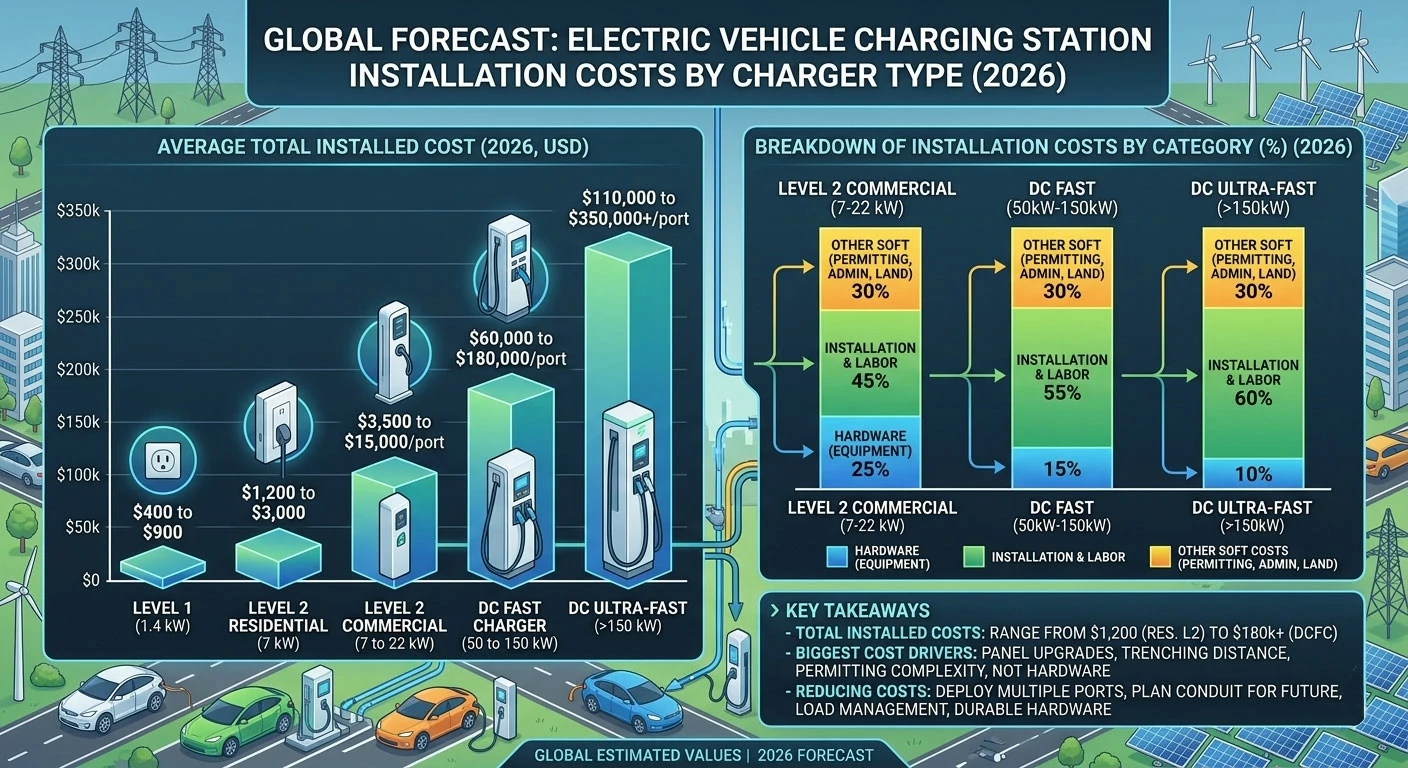
- Commercial Level 2 ports cost $3,500 to $15,000 per port fully installed; DC fast chargers run $60,000 to $180,000+ per port.
- The biggest cost variables are electrical panel upgrades, trenching distance, and permit complexity — not the charger hardware.
- The US Section 30C federal tax credit covers 30% of project costs (up to $100,000 per port) but expires June 30, 2026.
- Choosing durable, high-precision hardware reduces long-term maintenance costs and improves overall project ROI.
EV Charging Station Installation Cost by Charger Type
The type of charger you deploy sets the baseline for your entire project budget. Here is a realistic cost breakdown for 2026, including both hardware and installation.
| Charger Type | Hardware Cost | Installation Cost | Total Installed Cost |
|---|---|---|---|
| Level 1 (1.4 kW) | $300 to $600 | $100 to $300 | $400 to $900 |
| Level 2 Residential (7 kW) | $400 to $800 | $800 to $2,200 | $1,200 to $3,000 |
| Level 2 Commercial (7 to 22 kW) | $1,500 to $5,000/port | $2,000 to $10,000/port | $3,500 to $15,000/port |
| DC Fast Charger (50 to 150 kW) | $20,000 to $60,000 | $40,000 to $120,000 | $60,000 to $180,000/port |
| High-Power DCFC (150 to 350 kW) | $60,000 to $150,000 | $50,000 to $200,000 | $110,000 to $350,000+/port |
Level 1 Charging
Level 1 uses a standard 120V household outlet and costs almost nothing beyond a basic outlet installation. Charging speed is slow at roughly 3 to 5 miles of range per hour. It is suitable for employee parking at offices where vehicles sit for 8 to 10 hours, but not viable for any public or commercial high-throughput application.
Level 2 Charging Station Installation Cost
Level 2 is the most common deployment for residential homes, commercial parking, hospitality, and workplace charging. At 240V with outputs from 7 to 22 kW, a Level 2 charger delivers 20 to 30 miles of range per hour. Residential installations typically cost $1,200 to $3,000 total. Commercial installations, which often involve longer cable runs, conduit work, and panel upgrades, range from $3,500 to $15,000 per port.
DC Fast Charger Installation Cost
DC fast chargers are where project budgets grow dramatically. The hardware is only part of the story. Installation for a 50 to 150 kW DCFC typically costs $40,000 to $120,000 per port because it requires dedicated high-voltage service, significant trenching, utility upgrades, and specialised electrical labour. Projects deploying 120 to 180 kW fast charging stations at highway service areas or fleet depots need to factor in utility interconnection timelines that can extend 6 to 18 months on their own.
What Drives EV Charging Station Installation Costs
The charger hardware is rarely the most expensive line item on a commercial project. Here is what actually drives your installation costs up.
Distance from the Electrical Panel
The further a charging station sits from your main electrical panel, the more conduit, cable, and labour are required. Trenching typically costs $50 to $200 per linear foot depending on terrain.
Electrical Panel and Service Upgrades
Older buildings frequently lack the electrical capacity to support multiple EV chargers. Panel upgrades for residential applications cost $1,500 to $3,000. For commercial properties adding multiple DC fast chargers, a service upgrade can run $10,000 to $50,000 or more. Sites deploying more than 200 kW of total charging capacity may need a dedicated utility transformer, adding both cost and months to the project timeline.
Site Work and Trenching
Installing charging stations in open parking lots often requires trenching underground conduit from the electrical service point to each charger location. Rocky terrain, existing underground utilities, or paved surfaces all increase trenching complexity and cost. Planning conduit runs carefully during initial construction saves 5 to 10 times the cost of re-excavation when retrofitting later.
Permitting and Inspections
Most jurisdictions require electrical permits for EV charger installation. Permit fees range from $50 to $800 depending on location. According to the US Department of Energy’s Alternative Fuels Data Center, many regions have streamlined EV permitting, but high-power DCFC installations remain subject to longer review timelines.
Labour and Regional Rates
Electrical labour rates vary significantly by market. In major US metros and Western Europe, licensed electricians charge $80 to $150 per hour. In Southeast Asia or Eastern Europe, labour costs are considerably lower, but the availability of electricians with EV-specific experience may be limited.
Commercial EV Charging Station Installation: Full Cost Stack
For commercial and public charging deployments, the installation cost extends well beyond hardware and labour.
One-time capital costs:
- Hardware (charger units and mounting hardware)
- Electrical installation and panel upgrades
- Trenching, conduit, and cabling
- Permit and inspection fees
- Network commissioning and software setup
Ongoing operating costs:
- Network software and management fees ($50 to $200 per port per month)
- Routine maintenance and inspections (~$400 per Level 2 charger per year)
- Electricity costs and demand charges (demand charges can represent 23% to 85% of DCFC operating expenses at low-utilisation sites)
- Warranty and parts replacement over time
Commercial properties and fleet depots should build all of these into a full lifecycle cost model. The sites that achieve 3 to 5 year payback periods do so by anticipating operating costs upfront and selecting hardware built to minimise unplanned maintenance.
Looking to understand which charger configuration fits your project? Our EV charger selection guide walks through the key decisions by use case.
How Hardware Quality Affects Your Total Cost
The hardware you choose does not just affect your upfront installation cost — it shapes your total cost of ownership over 5 to 10 years.
A logistics company in Thailand that deployed a fleet charging depot chose a lower-cost manufacturer with thinner steel enclosures and recycled components to cut upfront costs. Within 18 months, four units had failed from corrosion in the humid tropical environment. Replacement costs, including shipping and reinstallation, came to $3,200 per failed unit. The “savings” from cheaper hardware had evaporated within two years.
Durable construction directly reduces long-term cost exposure. Klitv chargers feature a 2.0mm thickened steel body with high-precision components and no recycled materials, specifically engineered for consistent outdoor performance across varied climates. Every unit undergoes rigorous quality inspection before leaving our manufacturing facility, reducing the failure rate that drives hidden replacement and maintenance costs.
When evaluating hardware suppliers, factor in EV charger certifications and safety standards alongside the unit price. Certified, durable hardware consistently delivers lower total project cost.
How to Reduce EV Charging Station Installation Costs
Deploy multiple ports simultaneously. Sites deploying six or more charging ports at once achieve significantly lower per-port installation costs than phased deployments. Shared trenching, conduit, and panel upgrade work spreads fixed costs across more units.
Plan conduit for your 5-year buildout, not just today. Installing a 4-inch conduit at initial build costs marginally more than a 2-inch conduit — but re-trenching in three years costs 5 to 10 times more.
Use load management to avoid service upgrades. Smart charging systems can intelligently distribute power across multiple units during peak periods. Some sites avoid $20,000 to $50,000 service upgrades entirely by deploying load-managed charging. Klitv’s OCPP 1.6-compliant chargers integrate with commercial energy management platforms to enable this approach.
Source certified hardware from established manufacturers. For international projects, working with a manufacturer that has global shipping experience reduces deployment errors and rework. Learn more about what to look for when sourcing EV chargers from China.
Federal Tax Credits and Incentives in 2026
The US Section 30C Alternative Fuel Vehicle Refueling Property Credit covers 30% of total eligible project costs, capped at $100,000 per charging port.
To qualify, chargers must be located in eligible census tracts and placed in service before June 30, 2026. Full eligibility details are available on the DOE Alternative Fuels Data Center 30C credit page. Beyond the federal credit, many states and utilities offer additional rebates that can reduce total installation costs by 20% to 50% when stacked with the 30C credit.
For international deployments outside the US, import duties, local certification requirements, and regional utility tariffs all affect total project economics. The Germany Autobahn highway charging project illustrates how thorough pre-planning reduces cost surprises in international markets.
For a deeper look at available products, explore Klitv’s full EV charger range covering AC and DC solutions from 7 kW to 720 kW. Contact our team to discuss your project requirements or request a quote.